
How To Generate Name Efficiently

Master proven techniques to create memorable, available names for any project efficiently.
Core Methods
Combines word association, portmanteau construction, and linguistic roots with generator tools to produce hundreds of brandable options quickly.What You Gain
Systematic frameworks eliminate creative blocks, while validation checklists prevent costly trademark conflicts and ensure cross-platform availability.Critical Checkpoint
Always verify domain, social media, and trademark availability before finalizing. Names that sound perfect often fail legal clearance.
Staring at a blank screen hoping for the perfect name wastes hours most creators don't have. I've broken down the exact frameworks professional namers use—from manual techniques to AI-powered generators—so you can systematically create distinctive names that actually pass availability checks.
Understanding Name Generation Fundamentals
Productivity Boost with AI
SignificantName generation is the systematic process of creating unique, memorable identifiers for characters, businesses, projects, or digital personas. At its core, efficient name generation combines linguistic patterns, cultural awareness, and strategic methodology to produce names that resonate with your target audience while serving their intended purpose.
The foundation of efficient name generation rests on three pillars: clarity of purpose, understanding your constraints, and leveraging the right tools or techniques. Before generating any name, you must define what the name needs to accomplish. A gaming username requires different characteristics than a business name—the former prioritizes memorability and uniqueness, while the latter demands professionalism and market relevance.
According to research on AI productivity tools, employees using AI report an average 40% productivity boost, demonstrating how automated tools can significantly accelerate creative processes like name generation.
Defining Your Naming Objectives
Start by establishing clear parameters for your naming project. Ask yourself: What is this name representing? Who is the target audience? What emotions or associations should it evoke? For startups, names must convey innovation and scalability. For gamers, names should reflect personality and gaming style. For YouTubers, names need to be searchable, memorable, and brandable across platforms.
Document your requirements in specific terms. Instead of “I need a cool name,” define it as “I need a 6-10 character username that suggests speed and technology, easy to pronounce, and available on Twitch and YouTube.” This precision transforms vague ideas into actionable criteria.
Identifying Naming Constraints and Requirements
Every naming project operates within constraints that shape your generation strategy. Length restrictions are common—according to X (Twitter) official guidelines, your username cannot be longer than 15 characters. Similarly, Instagram username limits specify that the Instagram max username length is 30 characters.
Research from cognitive psychology studies reveals that companies with shorter business names (4-8 characters, 1-2 syllables) significantly outperform longer alternatives across funding success, stock performance, and brand recall metrics. Business names ideally stay between 4-8 characters with 1-2 syllables for optimal memorability.
Availability requirements matter significantly; you’ll need to check domain availability for businesses, username availability across platforms for digital personas, and trademark conflicts for commercial ventures.
Cultural and linguistic constraints also play critical roles. Names that work brilliantly in English may have unfortunate meanings in other languages. If your audience is international, test your generated names across multiple languages to avoid embarrassing mishaps. Similarly, consider pronunciation clarity—names that look interesting on paper but confuse people when spoken aloud create friction in word-of-mouth marketing.
Establishing Your Name Style and Tone
The stylistic direction of your names dramatically impacts their effectiveness. Descriptive names explicitly state what something does (QuickBooks, YouTube), making them immediately understandable but potentially limiting future expansion. Abstract names (Apple, Nike) offer flexibility and emotional resonance but require significant marketing investment to build meaning.
According to domain naming research, brandable domains can also withstand any changes that may occur with your business. A name that is too specific may restrict you later if you expand your offerings or change the direction of your company. With a name you can grow with, there is no limit to your potential.
Consider whether you want invented words (Spotify, Xerox), compound words (Facebook, Snapchat), modified spellings (Lyft, Fiverr), or acronyms (IBM, NASA). Each approach has distinct advantages: invented words offer uniqueness and trademark protection, compounds combine familiar concepts for instant understanding, modified spellings create distinctiveness while maintaining recognizability, and acronyms work well for lengthy organizational names.
Mastering Manual Name Generation Techniques
Manual Name Generation Process
Word Association
Connect related concepts and synonyms
Portmanteau Construction
Blend two words into one term
Modifier-Base Framework
Pair adjectives with base nouns
Cultural Mining
Draw from mythology and history
Manual name generation techniques give you complete creative control while developing your naming instincts. These methods work exceptionally well when you need highly personalized names or want to understand the underlying principles before using automated tools.
The most effective manual techniques combine structured frameworks with creative exploration. Rather than staring at a blank page hoping for inspiration, you systematically explore naming territories using proven methodologies that professional namers employ.
The Word Association Method
Word association builds names by connecting related concepts until you discover compelling combinations. Begin with your core concept—if you’re naming a gaming character who’s a rogue assassin, start with words like “shadow,” “blade,” “night,” “silent,” “phantom.” Write these in the center of your workspace.
For each core word, branch out with synonyms, related concepts, and emotional associations. “Shadow” connects to “umbra,” “shade,” “eclipse,” “dusk,” “silhouette.” “Blade” connects to “edge,” “steel,” “razor,” “shard,” “talon.” Now combine words from different branches: ShadowTalon, EclipseBlade, UmbraShard, DuskRazor.
Extend this technique by adding prefixes and suffixes that enhance meaning. Add “Dark-” prefix: DarkEclipse, DarkTalon. Add “-ix” or “-ax” suffixes for edgy gaming feel: Shadowix, Bladeax, Umbrax. Mix linguistic roots—Latin, Greek, Japanese—to create exotic-sounding combinations: NoxBlade (Latin “nox” = night), KageSteel (Japanese “kage” = shadow).
The Portmanteau Construction Approach
Portmanteaus blend two words into a single cohesive term, creating names that feel familiar yet distinctive. According to naming trend analysis, Microsoft (microcomputer + software), Pinterest (pin + interest), and Instagram (instant + telegram) are prime examples of this trend’s effectiveness.
Identify two words that capture your concept’s essence. For a productivity app targeting students, you might combine “focus” and “student,” or “study” and “momentum.” The key is finding the natural fusion point where words blend smoothly. Try different combinations: FocusStudent becomes “Focent” or “Studocus.” StudyMomentum becomes “Studmentum” or “Momentudy.”
Test phonetic variations by shifting the blend point. Take “Instagram” (instant + telegram)—the creators could have chosen “Instegram,” “Instatelegram,” or “Telinstant,” but “Instagram” had the best sound and rhythm. Experiment with keeping different syllables from each word: beginning of first + end of second, or vice versa.
The Modifier-Base Framework
This systematic approach pairs descriptive modifiers with base nouns to generate structured names. It works particularly well for business names, project titles, and character names requiring specific attributes.
Create two lists: modifiers (adjectives, colors, qualities) and bases (nouns, objects, concepts). For a YouTube gaming channel, your modifier list might include: Epic, Legendary, Quantum, Cosmic, Primal, Apex, Nova, Nexus. Your base list could include: Gamer, Player, Squad, Legion, Force, Realm, Arena, Zone.
Systematically combine them: EpicGamer, QuantumSquad, CosmicArena, ApexRealm, NovaForce. This generates dozens of combinations quickly. Refine by adding connecting words or modifying spelling: Epic Gaming Zone becomes EpicGamingZone or EpicGameZone. Cosmic Arena becomes CosmicArenaHQ or TheCosmicArena.
The Cultural and Mythological Mining Method
Drawing from mythology, history, and world cultures provides rich naming material with built-in storytelling power. This technique requires some research but yields distinctive, meaningful names that carry deeper resonance.
Explore mythological figures, places, and concepts from various traditions. Greek mythology offers names like Athena (wisdom), Hermes (speed, communication), Prometheus (innovation). Norse mythology provides Thor (strength), Loki (trickery), Freya (beauty). Egyptian mythology contributes Anubis (guardian), Ra (power), Thoth (knowledge).
Don’t use these names directly—modify them to create original variations. Athena becomes Athenis, Athenix, Athenova. Prometheus becomes Promethean, Promethos, Prometix. Combine mythological elements with modern words: AthenaTech, PrometheusLabs, LokeGaming, RaForce.
Research cultural words for concepts you want to embody. The Japanese “kaizen” (continuous improvement) could inspire KaizenStudy or KaizenGrowth. The Swahili “ubuntu” (humanity) could become UbuntuConnect. The Sanskrit “satya” (truth) could generate SatyaMedia.
Leveraging Name Generator Tools Effectively
Naming Objectives Checklist
5 essentials- 1 Define what the name represents
- 2 Identify your target audience
- 3 Determine emotions to evoke
- 4 Set specific character limits
- 5 Document requirements in detail
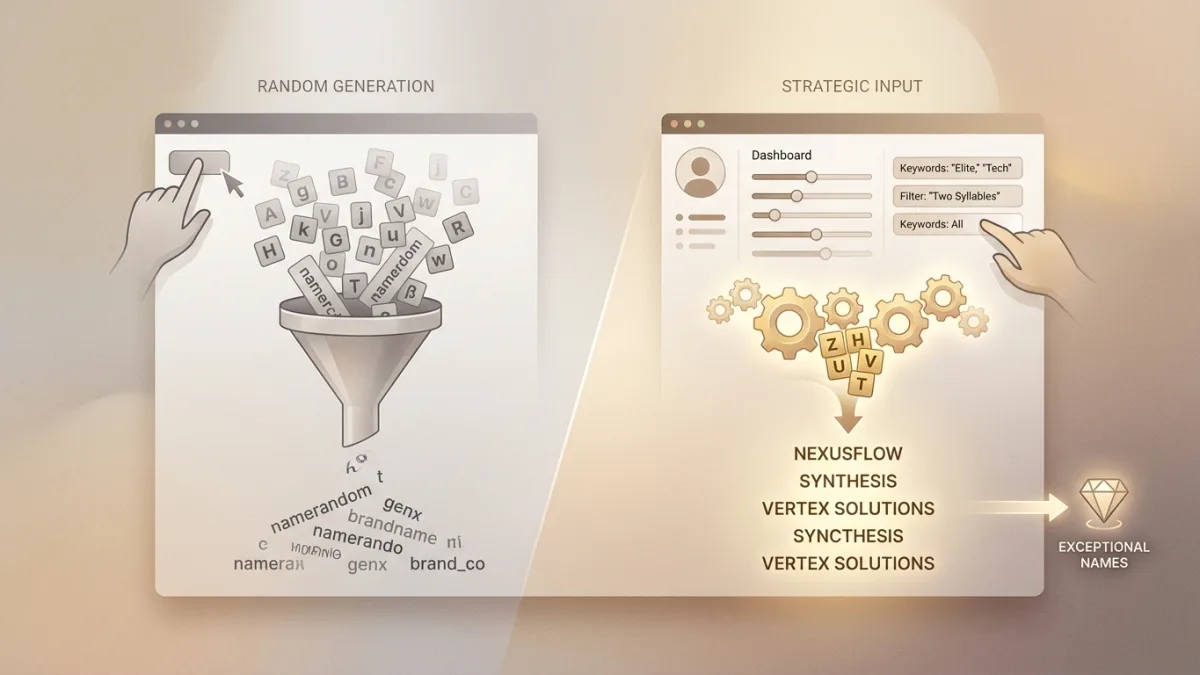
Name generator tools exponentially accelerate the naming process by exploring thousands of combinations in seconds. However, tool effectiveness depends entirely on how you use them. Random generation without strategic input produces mediocre results; strategic use with refined parameters yields exceptional names.
Modern name generators employ various algorithms—some combine word lists randomly, others use linguistic patterns, and advanced tools apply machine learning to generate names matching specific styles. Understanding these mechanisms helps you extract maximum value from each tool type.
Choosing the Right Generator Type
Different generators serve different naming needs. Random name generators create unique combinations from predefined word lists, ideal for quick brainstorming and discovering unexpected combinations. Fantasy name generators use phonetic patterns from fictional languages, perfect for game characters, fictional worlds, and creative projects.
Business name generators typically incorporate domain availability checking and branding considerations, essential for startups and commercial ventures. According to Looka’s business name generator, modern AI tools review generated names, filter by length, and instantly check domain and social availability.
Username generators focus on platform availability and character limits, crucial for social media presence. Acronym generators create pronounceable abbreviations from longer phrases, useful for organizations and technical projects.
Free Name Generator offers specialized tools for various naming scenarios—character names for gamers, business names for startups, and username generators for YouTubers establishing their digital presence. Each tool applies different algorithms optimized for its specific use case.
Optimizing Generator Input Parameters
The quality of generator output directly correlates with input quality. Generic inputs like “cool name” produce generic results. Specific inputs like “8-character tech startup name suggesting speed and innovation” generate focused, relevant options.
Provide multiple seed words rather than single terms. Instead of inputting just “dragon,” try “dragon, fire, ancient, power, sky.” Generators combine these in various ways, producing richer results: DragonFire, SkyDragon, AncientFlame, PowerWing, DracoSky.
Adjust length parameters strategically. For usernames, limit to 12-15 characters for platform compatibility. For business names, target 2-3 words maximum. For character names, consider the fictional culture—elven names might be longer and flowing, while dwarf names might be short and harsh.
Batch Generation and Filtering Strategy
Efficient name generation involves producing large quantities, then systematically filtering for quality. Generate a substantial number of names in your initial batch. This abundance ensures you don’t settle for mediocre options and allows pattern recognition—you’ll notice which styles resonate most.
Apply progressive filtering criteria. First pass: eliminate names that are too long, difficult to pronounce, or immediately unappealing. Second pass: remove names too similar to existing brands or competitors. Third pass: check availability (domain, username, trademark). Fourth pass: test pronunciation and memorability with others.
Use spreadsheet organization to track your generated names. Create columns for: name, length, pronunciation difficulty (1-5 scale), domain availability, platform availability, personal rating, and notes. This systematic approach prevents losing promising candidates and enables objective comparison.
Combining Multiple Generator Outputs
No single generator produces perfect results consistently. Cross-pollinate by using multiple tools and combining their best outputs. Generate names from a fantasy generator, a business generator, and a random word combiner. Your best name might emerge from merging elements from different sources.
Take partial elements from generated names to create new combinations. If one generator produces “ShadowKnight” and another produces “DarkBlade,” you might create “ShadowBlade,” “DarkKnight,” “ShadowSteel,” or “NightBlade.” This hybrid approach leverages algorithmic creativity while maintaining human curation.
Validating and Testing Name Candidates
Generating names is only half the process—validation determines which names actually work in real-world applications. A name that looks perfect on paper might fail pronunciation tests, conflict with existing trademarks, or confuse your target audience.
Systematic validation prevents costly mistakes. Businesses have rebranded after discovering their chosen name had unfortunate meanings in key markets. Gamers have lost established usernames due to platform policy violations. YouTubers have struggled with names that don’t appear in search results.
Conducting Availability Checks
Start with domain availability for any name requiring web presence. Check .com availability first, as it remains the most credible extension. According to domain search tools, modern platforms show available domains in less than 25 milliseconds using powerful AI and instant search infrastructure. If your exact name isn’t available, consider slight variations—adding “get,” “try,” “app,” or “hq” as prefixes/suffixes.
For social media presence, verify username availability across relevant platforms simultaneously. Tools exist that check multiple platforms at once, saving hours of manual searching. Priority platforms vary by use case: gamers need Twitch, Discord, Steam; YouTubers need YouTube, Instagram, TikTok, Twitter; startups need LinkedIn, Twitter, Facebook, Instagram.
Conduct trademark searches for business names to avoid legal complications. The United States Patent and Trademark Office (USPTO) provides a comprehensive trademark search database. According to USPTO guidance, searching the United States Patent and Trademark Office’s (USPTO) federal trademark database is one essential step in the clearance process.
Testing Pronunciation and Memorability
The say-it-out-loud test reveals pronunciation issues invisible on screen. Say your candidate names aloud ten times rapidly. Names that cause stumbling, feel awkward, or sound unintentionally humorous fail this test. “Pronounceability” is crucial—if people can’t say your name, they can’t recommend you verbally.
Research from brand psychology studies found that online sellers with short, easy-to-pronounce names were perceived as 31% more trustworthy than those with complex, long names.
Test spelling memorability by telling someone your name verbally, then asking them to write it down without seeing it. If they consistently misspell it, your name creates friction. Modified spellings like “Lyft” or “Fiverr” work because the correct spelling is guessable; overly creative spellings like “Phyntastik” create constant correction burden.
Conduct the recall test with 5-10 people from your target audience. Show them a list of 10 names (including your candidates) for 30 seconds, then remove the list and ask which names they remember five minutes later. Names that stick in memory have better brand potential.
Evaluating Cultural and Linguistic Appropriateness
Check your name across multiple languages to avoid embarrassing meanings. While the famous Chevrolet Nova story is actually a myth—the Nova actually sold well in Spanish-speaking markets—linguistic screening remains important. Use translation tools and native speaker consultations to vet names for international markets.
Consider phonetic associations in your target markets. Some sound combinations carry negative connotations in specific cultures. Research cultural naming taboos—certain numbers, colors, or animals have specific meanings that might conflict with your intended message.
Evaluate age appropriateness for your audience. Names targeting youth can be edgier and more playful; names for professional services require gravitas. A name like “SavageGamer” works for a teenage Twitch streamer but fails for a business consulting firm.
Gathering Stakeholder Feedback
Present your top 3-5 candidates to trusted advisors, potential users, or team members. Structure feedback requests specifically: “Which name best suggests [desired quality]?” rather than “Which do you like?” Preference questions yield subjective opinions; strategic questions yield actionable insights.
Use A/B preference testing by showing pairs of names and asking which better fits specific criteria. “Which sounds more professional: QuantumLeap or NovaForce?” “Which is easier to remember: TechNexus or InnovateSphere?” Pairwise comparison reveals relative strengths more clearly than rating names individually.
Create a feedback matrix collecting responses across multiple dimensions. Aggregate scores reveal which names perform strongest across your priority criteria. Weight scores according to what matters most—if memorability trumps professionalism for your use case, prioritize accordingly.
Refining and Finalizing Your Generated Names
Brandable Names Advantage
Brandable domains can withstand any changes that may occur with your business. A name that is too specific may restrict you later if you expand your offerings.
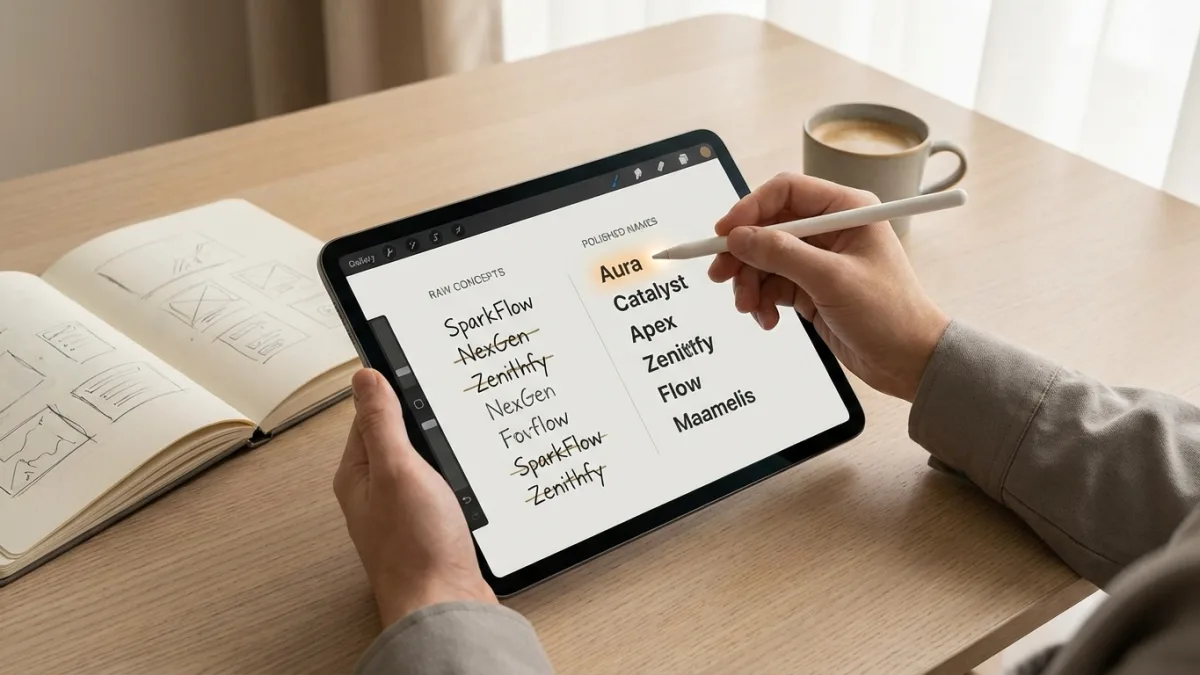
Domain naming researchRaw generated names rarely achieve perfection immediately. Refinement transforms good candidates into great names through strategic modification, enhancement, and polish. This stage separates amateur naming from professional-grade results.
The refinement process involves multiple techniques: phonetic optimization, visual enhancement, meaning deepening, and strategic variation. Each technique addresses specific weaknesses while amplifying strengths.
Applying Phonetic Optimization Techniques
Analyze the sound patterns of your candidate names. According to brand naming psychology research, brand names between six and eight characters perform best in memory tests. This sweet spot allows for sufficient distinctiveness while maintaining ease of recall.
Hard consonants (K, T, P, D) create strength and impact—ideal for gaming, sports, or aggressive brands. Soft consonants (L, M, N, S) create smoothness and approachability—better for education, wellness, or community brands.
Optimize syllable rhythm for memorability. Two-syllable names (Google, Apple, Facebook) offer simplicity and punch. Three-syllable names (Amazon, Microsoft, Instagram) provide sophistication and completeness. Single-syllable names (Stripe, Slack, Zoom) deliver maximum impact but face higher availability challenges.
Consider alliteration and assonance for enhanced memorability. PayPal, Coca-Cola, and TikTok use alliteration (repeated initial consonants). Assonance (repeated vowel sounds) appears in names like YouTube and Hulu. These devices make names more pleasant to say and easier to remember.
Enhancing Visual Appeal and Branding
Evaluate how your name looks written. Some names sound great but appear awkward visually. Test different capitalizations: lowercase (facebook), uppercase (IBM), CamelCase (YouTube), or mixed (eBay). Visual presentation impacts brand perception significantly.
Assess logo potential by sketching rough concepts. Names with interesting letter shapes or natural visual metaphors translate better into logos. Consider whether the first letter or full name creates stronger visual impact. Single-letter logos (McDonald’s M, Twitter bird) require extremely strong brand recognition.
Check typography compatibility by viewing your name in various fonts. Some names look excellent in modern sans-serif fonts but weak in traditional serifs, or vice versa. Your name should maintain appeal across different typographic treatments since you’ll use it in various contexts.
Creating Strategic Name Variations
Develop multiple versions of your top candidates to maximize flexibility. Create short forms, long forms, and variations with different prefixes/suffixes. “Quantum” might expand to “Quantum Labs,” “Quantum Solutions,” or “The Quantum Collective.” Each variation serves different contexts while maintaining core identity.
Build tagline integration by testing how your name pairs with descriptive phrases. “Quantum: Accelerating Innovation” or “Quantum – Where Ideas Evolve.” Names that complement taglines rather than compete with them offer stronger branding potential.
Consider scalability for future growth. If you’re naming a YouTube gaming channel now but might expand into streaming, merchandise, or events later, ensure your name doesn’t limit expansion. “JohnPlaysMinecraft” restricts you to one person playing one game; “QuantumGaming” allows growth.
Securing Your Final Selection
Once you’ve selected your final name, secure it immediately across all relevant platforms before announcing publicly. Register the domain even if you won’t use it immediately—domain squatters monitor naming trends and register promising names for resale.
Create accounts on all major social media platforms using your chosen name, even platforms you don’t plan to use immediately. This prevents impersonation and preserves future expansion options. Set up basic profiles to establish presence and prevent confusion.
Document your naming rationale in writing. Record why you chose this name, what it represents, and how it aligns with your goals. This documentation proves invaluable when explaining your brand to partners, investors, or team members, and prevents second-guessing during inevitable moments of doubt.
Implementing Advanced Name Generation Strategies
Naming Style Comparison
Advanced strategies combine multiple techniques, leverage psychological principles, and apply systematic creativity to generate names that transcend ordinary results. These approaches require more effort but produce distinctly superior outcomes for high-stakes naming projects.
Professional namers employ these strategies when standard methods produce adequate but uninspiring results, or when naming projects carry significant business or creative consequences.
The Linguistic Root Combination Method
Mining linguistic roots from Latin, Greek, Sanskrit, and other ancient languages creates sophisticated, meaningful names with built-in depth. This technique produces names like “Verizon” (veritas + horizon), “Accenture” (accent + future), and “Agilent” (agile + intelligent).
Research root words relating to your core concepts. For a learning platform, explore roots meaning “knowledge,” “growth,” “wisdom,” “discover.” Latin “cogn-” (know), Greek “soph-” (wisdom), Sanskrit “bodhi-” (awakening), Latin “disc-” (learn). Combine roots from different languages: CogniSphere, SophiaLearn, BodhiPath, DiscovEra.
Apply morphological modification to make roots more brandable. Add common endings: -ify (Spotify), -ly (Bitly), -ium (Medium), -ify (Shopify), -ster (Napster). Transform roots with prefixes: re-, pro-, pre-, meta-, ultra-. “Cogn” becomes Recognia, Procognitive, Metacognition, Ultracogni.
The Emotional Resonance Framework
Names carrying emotional weight create stronger connections than purely descriptive names. According to neuroscience research on brand naming, the semantic relevance of a brand name can also significantly impact its memorability. Brands that evoke strong imagery or emotions are more likely to be stored in long-term memory.
This framework systematically embeds emotional triggers into your naming process, producing names that feel right intuitively while serving functional purposes.
Identify the primary emotion you want your name to evoke. Startups might target excitement, trust, or innovation. Gaming personas might aim for power, mystery, or humor. Educational projects might emphasize growth, discovery, or achievement. List 20-30 words associated with your target emotion.
Combine emotional words with functional descriptors using the techniques above. For a productivity app targeting students, combine achievement emotions (triumph, victory, excel, accomplish) with study concepts (focus, learn, master, study): TriumphStudy, VictoryFocus, ExcelLearn, AccomplishMaster.
Test emotional resonance by having test subjects rate names on emotional scales: inspiring (1-5), trustworthy (1-5), exciting (1-5), innovative (1-5). Names scoring highest on your priority emotions win selection.
The Constraint-Based Creativity Approach
Paradoxically, adding constraints often enhances creativity by forcing exploration of unconventional solutions. Professional namers use artificial constraints to break mental patterns and discover unexpected naming territories.
Impose length constraints: generate only 6-letter names, or only 2-syllable names. This forces creative solutions within tight parameters, often producing elegantly simple results. Twitter’s original constraint (140 characters) influenced its punchy, short name.
Apply alphabetic constraints: create names starting with specific letters, or using only certain letter combinations. Require your name to contain double letters (Google, Yahoo, Shutterfly) or specific phonemes. These arbitrary rules push you into unexplored naming space.
Use conceptual constraints: generate names using only nature words, only color words, only geometric terms, or only musical concepts. “Spotify” emerged from “spot” and “identify”—music concepts. This focused exploration often yields distinctive results.
The Competitive Differentiation Analysis
Analyze competitor names systematically to identify strategic differentiation opportunities. If all competitors use descriptive names, consider abstract names. If competitors favor long names, go short. If they use technical terminology, choose accessible language.
Create a competitor name matrix documenting patterns. Identify the naming white space—approaches competitors haven’t used. If everyone uses serious, technical names, a playful, accessible name might stand out. If everyone uses invented words, a clear descriptive name might differentiate through clarity.
Balance differentiation with industry expectations. Being radically different attracts attention but might signal you’re not a serious player. Being too similar makes you forgettable. Find the optimal distinctiveness—familiar enough to be credible, different enough to be memorable.
Frequently Asked Questions
In 1984, a California court ruled that changing a name to just “III” would be confusing since it was a symbol as much as a number and not a legitimate name. Most states restrict having numerals in your name due to database limitations and record-keeping systems. This restriction applies to Roman numerals, Arabic numbers, and symbols that cannot be processed by official government databases. Computer systems wouldn’t know how to handle numbers in a database that looks for letters in a name field.
According to Nameberry’s research, there are fewer than five girls with the name Hester in the US, which hails from the romance novel The Scarlet Letter, first published in 1850. Other exceptionally rare names include Ottilie and Lilac, each with fewer than 25 registered individuals. Rarity varies significantly by region and culture, as names considered rare in one country may be common elsewhere. When selecting a unique name, consider pronunciation ease and long-term suitability.
States restrict the use of certain words like “bank” or “insurance” in LLC names, and LLC names must be distinguishable from other registered names in the state. Names cannot imply a relationship with government agencies (e.g., “Bureau,” “Federal,” “County,” or “Commission”). Words like “bank” or “insurance” may require approval from specific state agencies before they can be included in your company name. Additionally, avoid trademarked names, offensive language, and overly specific terms that may limit your business growth.
AI generators can produce hundreds of name ideas in just minutes, giving you a wide range of options to explore without the usual stress or creative block. Modern generators also check domain availability and social media handles simultaneously, preventing the frustration of selecting unavailable names. This streamlined approach allows you to focus on evaluating quality options rather than generating them manually.
Modern AI tools check both domain names and social media handles to see if they’re available, so you won’t have to deal with the frustration of falling in love with a name that’s already taken. Advanced generators learn from user behavior, tracking which names you save to your favorites and which ones you scroll past, allowing the algorithm to refine its suggestions in real-time. Effective generators combine linguistic pattern analysis, industry-specific filtering, and trademark screening to deliver brandable, legally compliant suggestions that align with your business vision.
According to business naming trends research, purpose-driven branding is taking center stage, with companies choosing names that showcase their commitment to social causes. This resonates particularly well with Gen-Z consumers who expect brands to stand for something meaningful. Brandable names (like Google or Spotify) are generally preferred because they are unique, easier to trademark, and allow your business to pivot its services. Names that try too hard to describe everything tend to feel flat. What usually works better is something memorable first, with just enough relevance to hint at what the business does.
Conduct a three-tier verification process: state business registry search, federal trademark database check, and domain availability confirmation. The United States Patent and Trademark Office (USPTO) offers trademark protections for businesses and provides a digital search tool for brands to search existing trademarks proactively. Perform trademark search and check domain availability before finalizing your choice, as skipping this step can cost thousands in rebranding later. Many modern name generators integrate these checks automatically, saving valuable time during the selection process.